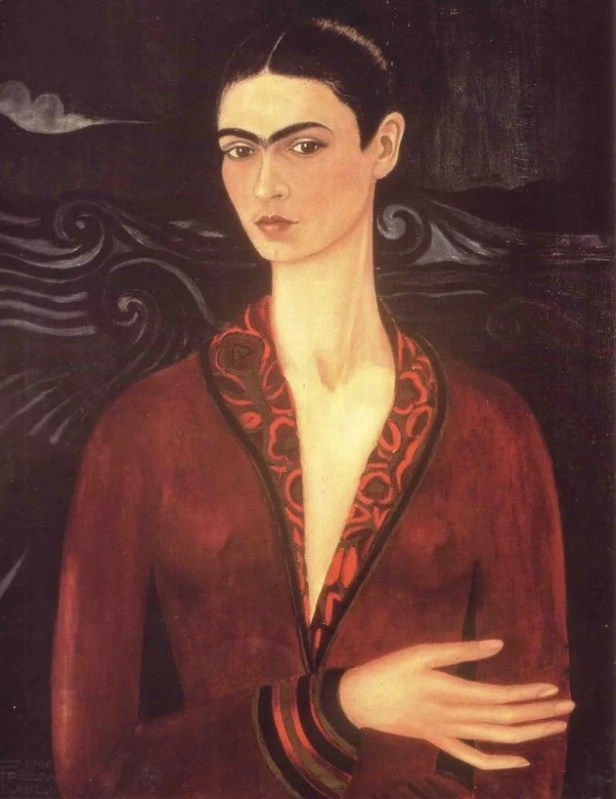
If any artwork has the mysterious gift of emanating a disturbing power, it is Frida Kahlo’s. Every element scattered on the canvas seems like it’s about to walk, to move; she herself seems to be alive. And alive, she jumps out of the painting to impose and imbue that power in every place she is found.
Frida vibrates beyond the canvas. Her strength comes from the depths and blesses everything she touches. That’s how she touched her painting, which she reached through sheer catastrophe, as Frida begins to paint at the age of 16, during the recovery from a bus accident where she was seriously injured. And all the energy that she cannot unleash with her legs, she pours into her painting. She delves into popular roots, and a fusion of identity occurs, becoming an aesthetic sign.

Her excessive imagination and her encounter with Breton lead her to surrealistic passion, creating true enigmas in the development of her themes. In fact, it is the surrealist poet who takes charge of organizing her exhibitions in New York.
Frida Kahlo is the mirror of strength where women look at themselves and rise to rebuild their true quality of being free. She experienced a cruel and continuous tearing apart in which she immolated herself almost daily. Every stroke, every color, she tore from her being and fixed it on the canvas, in such a way that it seems as if the canvas breathes. And it’s Frida. She’s there, watching us with a slight reproach in her gaze. We know why. At the same time, she takes care of us or plays a trick on us. That’s her way of giving herself. In the end, she places us at the top, whether it’s of love, ideas, art, everything, or nothing. And she goes away and returns like a corporeal wind, and she permeates our lives until she emerges provocatively, as if to say: I am awake, I am alive. And I tell you: live, Frida. Someone like you did not deserve to die.
Raysa White, Havana, 1999
AUTHOR’S NOTE: I will never tire of remembering Frida Kahlo. For her, this brief homage that I wrote at the end of the century, where I tried to summarize her intense life.
The phrase «strong as her soul» is a laudatory description of Frida Kahlo and her character. Throughout her life, Frida faced numerous physical and emotional challenges, including a serious bus accident that left her with permanent injuries, as well as a series of difficulties in her personal life. However, Frida demonstrated great inner strength and determination in facing these adversities.
Her art also reflects that emotional strength. Frida Kahlo used her painting as a way to explore and express her pain, personal experiences, and cultural identity. And through her work, Frida challenged the social and gender conventions of her time, becoming a feminist icon and a prominent figure in Mexican art, creating everything with a single brushstroke, the wound. One color, her blood. And a single canvas, her skin.
Your gift may be in my store


Connect with Akerunoticias, a newspaper that arrives with a selection of the most interesting content of the moment. It doesn’t matter if you live anywhere else on the planet, receive links to the most relevant news of the moment in your email inbox. Subscribe to our YouTube channel and enable notifications, and follow us on Facebook, Twitter and Instagram.

