We are living in a strange hour. An age where ideas are no longer always born from sleepless nights or trembling hearts, but from the electric hum of a neural network. Are we standing before a new muse, or merely listening to a polished echo of what once was?
Raysa White
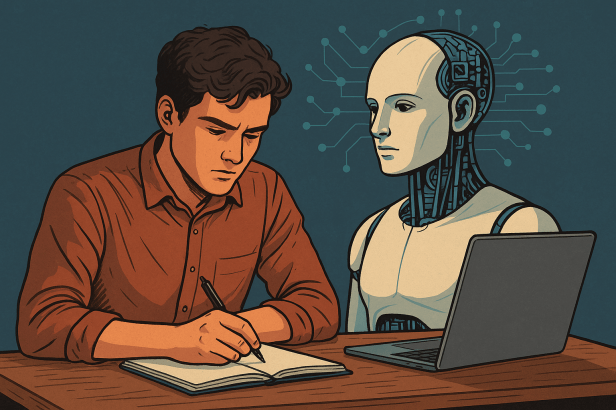
There are classrooms where blackboards shine less brightly than screens. And there are studios where the canvas no longer waits for brushes — but for prompts. Amidst it all, the soul of the educator and the artist hesitates, wondering if there is still room for trembling, for imperfection, for the sigh that cannot be programmed.
We’ve come so far ahead, that in Education we now ask: Who is teaching whom?
Artificial intelligence has entered our schools like an invisible wind — moving things without being seen. Sometimes it answers for the students. Sometimes it thinks for the teachers. Is this evolution, or an elegant form of forgetting?
Teaching was once a ritual of presence: a word set ablaze, a guiding gaze, a pause that planted questions. Today, speed runs over everything. But not all is lost. Perhaps AI could serve us — if we learn to tame it, if we force it to converse with sensitivity instead of replacing it. Because what is at stake is not access to knowledge, but the way that knowledge touches the human heart.
And in Art today… who signs beauty?
An algorithm can already compose a symphony, paint a portrait, imitate the voice of someone we love. But I wonder — can it weep while doing it? Can a robot, like an artist, stand before its work and say: “This hurts me”? AI can replicate styles, blend colors, tell stories, and find in the corners of the web what we ourselves cannot. But it cannot feel shame. Nor desire. Nor doubt. And without those, Art does not breathe.
The flesh-and-blood creator bleeds into their work. Through mistakes, through wild intuitions, through silence. AI works without night, without body. Without fatigue, yes. But also without epiphany.

So, is AI an ally or a threat?
Enough of stories, speculation, and fear. It depends on what we seek: efficiency or truth?
Artificial intelligence may be a lamp. But it cannot choose the road. It may be a bridge. But it will never be the shore. It may assist. But it will never be a voice. And it is precisely there — at that delicate threshold — where humans and robots might walk side by side.
The true creator creates because something burns within.
And until machines can burn from within,
we will go on needing poets.
We will go on needing teachers.
Artists of flesh and soul.
We will go on needing wonder.

